Build a list from scratch
Describe who you want to sell to — or let Saleshunt help you figure out who to target. Either way, you end up with a List of matching companies.
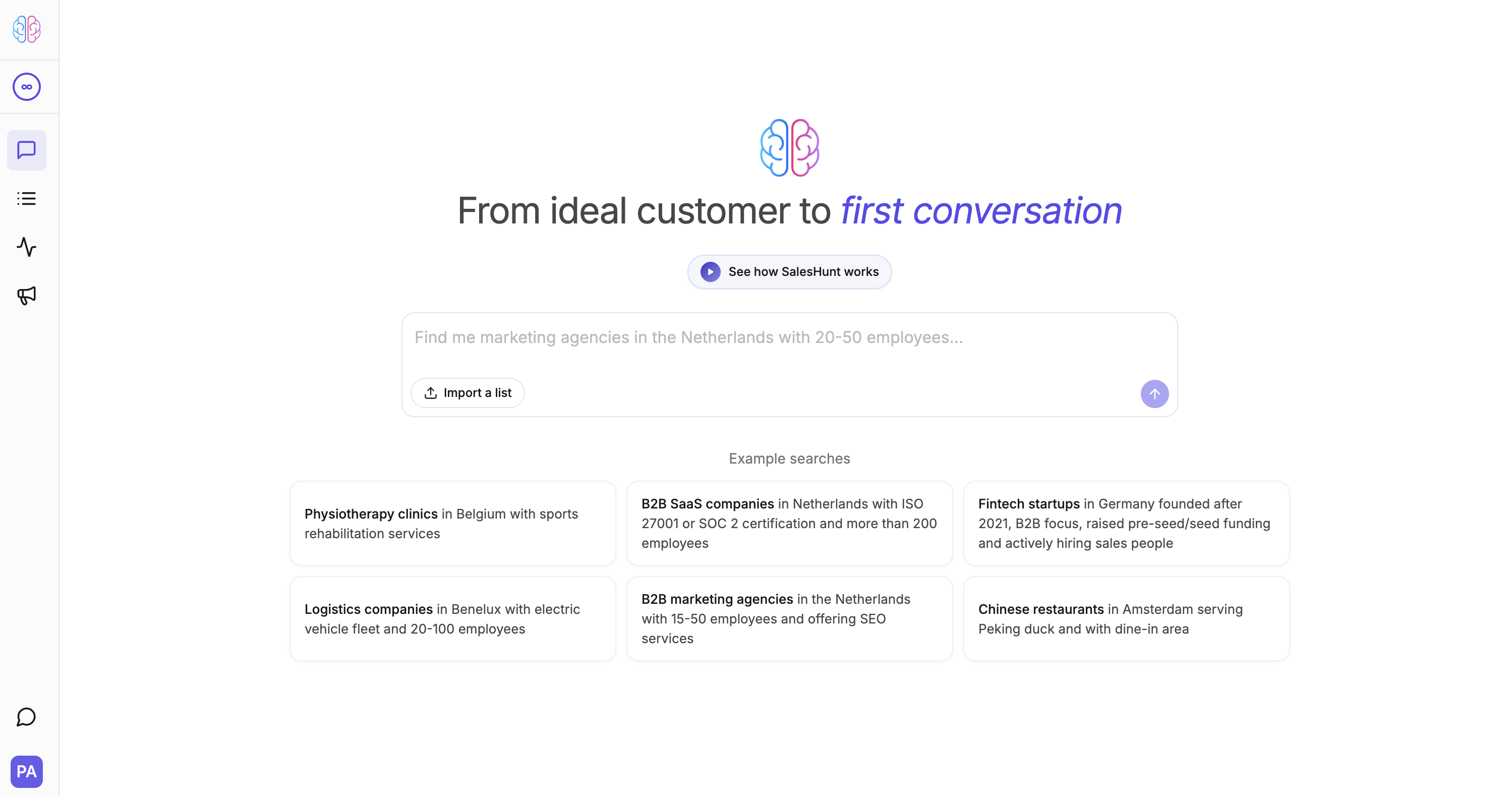
The chat-based path through Discover. Describe who you want to sell to in natural language and you end up with a List of perfect-match companies — no forms, no filters to configure.
Here's what makes it different: you don't need a finished ideal-customer profile to start. Discover works both ways.
- You already know who you're after — describe them, and Saleshunt builds the list.
- You're still figuring it out — tell Saleshunt what you sell, and it helps you work out who to target: it suggests sensible criteria, proposes how to read vague terms, and shapes the profile with you in the conversation. That's the discover in Discover — it's not just a search box, it helps you find your ideal customer in the first place.
Either way, Saleshunt asks clarifying questions as you go, so you land on a sharp target without doing the deduction work yourself.
How it works
Open Discover from the sidebar. The input is one free-text field — type the kind of customer you're looking for. Examples:
- "We sell a SaaS tool that helps e-commerce brands automate returns. Who should we target?"
- "B2B marketing agencies in the Netherlands with 10–50 employees offering SEO services."
- "Fintech startups in Germany founded after 2021, B2B focus, raised pre-seed/seed funding, actively hiring sales people."
Saleshunt parses the description and asks any clarifying questions it needs. Once you've settled on who you're targeting, it asks how many prospects you want — anywhere from 1 to 1,000. (Need more than 1,000? Get in touch and we'll sort it out.) That kicks off a real-time search across the web and a range of data sources, and the matching companies land in a new List.
What to put in the search
Anything that's a real signal of fit for your business. The more specific, the better the results. The highest-signal filters, roughly in order:
- Geography — country, region, city. Almost always the most important filter
- Industry or vertical — "fintech", "SaaS", "logistics"
- What they do or who they serve — go past the vertical to the value proposition. "fintech companies offering lending to small businesses", "agencies that run paid social for e-commerce brands". This is often the difference between a broad list and a sharp one
- Specific characteristics — "founded after 2021", "hiring sales", "raised in the last 18 months"
Layer on other signals where they help:
- Company size — headcount or revenue range
- Funding stage — seed, Series A, post-IPO
- Tech stack — "uses Salesforce", "runs on Shopify"
Writing filters that work
Two principles decide whether a filter gives you good results. Get these right and the system is in the best possible position to deliver.
The feasibility test: "could a human find this online?"
Saleshunt's agents find companies two ways — matching against company profiles (what a company is and does) and reading what's publicly available online (websites, search results, public pages). The rule of thumb:
If you could find it yourself by browsing the internet, Saleshunt can probably find it too. If it needs insider access, a login, or a crystal ball, it can't.
Filters that work well — publicly visible, no rephrasing needed:
- Location and geography
- Industry or vertical
- Specific services, products, or facilities they offer
- Founding year, employee count, certifications (ISO, SOC2, B Corp)
- Technologies on their website or in job postings
- Public funding rounds, partnerships, news mentions
Filters that could be better with rephrasing — not directly findable as written, so turn them into observable proxies:
| What you wrote | Why it's hard | Rephrase as |
|---|---|---|
| "Startups" / "enterprise" | Means different things to different people | A concrete reading — "founded in the last 5 years, under 50 employees" |
| "Innovative" / "fast-growing" | No public fact proves it directly | Observable signals — recent funding, rapid hiring, expanding to new markets |
| Revenue / profit | Not public for most companies | A proxy — employee count or recent funding |
| "About to switch CRM" / "planning to expand" | Internal plans you can't see | Signals you can see — job postings for that role, competing tools on their site |
Disambiguation: say which side you mean
Some terms match two completely different groups of companies sitting at different points in the same value chain. "HubSpot companies" could mean agencies that build on HubSpot, or companies that use HubSpot. "Companies doing AI" could mean AI product companies, or companies adopting AI internally.
When your filter could split like that, say which side you want — it sharpens results and saves a clarifying round-trip.
The test: could this describe both a provider and a user of the same thing? If yes, specify. If it just describes what the company is ("SaaS companies", "law firms", "restaurants"), there's no split — go ahead.
Tips for better results
Start broad, then narrow. It's easier to tighten a query than to expand it. If your first run returns 800 companies, add a filter. If it returns 8, drop one.
- Combine 3–5 filters, not 10+. Each extra constraint shrinks the pool. The sweet spot is enough to be specific without disqualifying real matches
- Be specific about geography. "Netherlands" returns very different results than "Benelux" or "DACH". State the actual countries
- Use freshness signals. "hiring sales", "raised in the last 12 months", "founded after 2021" surface companies in motion, not snapshots